
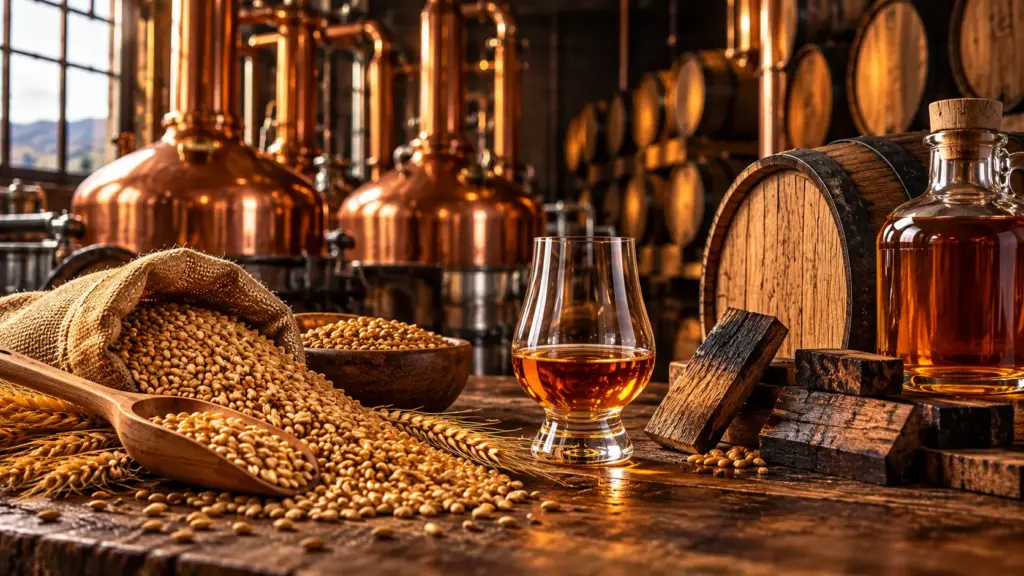
Whisky is one of the noblest, most complex and most respected drinks in the global spirits industry. Behind its understated amber color and rich bouquet of vanilla, peat smoke, ripe fruit and aged oak lie centuries of distilling expertise, rigorous physics and subtle biochemistry. In Tashkent today, whisky has earned the status of a universal drink: it is chosen both for prestigious business gifts and for cozy evenings with friends.
Yet many buyers wonder what whisky is really made from, why malt Scotch differs from American bourbon, and what role an ordinary wooden barrel plays in shaping its flavor.
In this guide, experts from the Saba Nine holding take you through every stage of whisky making and reveal how humble grain turns into liquid gold.
Four Pillars: The Basic Ingredients of Whisky
Real, high-quality whisky is made from a minimal set of natural ingredients. All the variety of flavors comes solely from how the raw materials are handled and processed.
- Grain:
- Barley: The main cereal for classic Scotch and Irish whisky. Barley malt is what gives us malt whisky (Single Malt).
- Corn: The main raw material for American bourbon (by US law it must make up at least 51%).
- Rye and wheat: Used to make rye whisky (Rye) or as a soft grain addition in blends.
- Water: The purest natural water from mountain springs, peaty wells or underground boreholes. The composition and mineral content of the water directly affect the smoothness of the future spirit.
- Yeast: Special strains of distiller’s or wine yeast that turn the sugars from the grain into alcohol and create the first fruity esters.
- Peat (for smoky whiskies): The traditional Scottish fuel whose smoke is used to dry the damp barley malt, giving the whisky its famous creosote, iodine and smoky aroma.
Step by Step: How Is Real Whisky Made?
Making whisky is a long, multi-stage process that demands meticulous precision at every step.
Stage 1: Malting the Barley
Selected barley is soaked in water and spread on a flat floor so that the grain begins to germinate. As it sprouts, enzymes are activated inside the grain that can break starch down into sugar. As soon as the first shoots appear, the process is stopped by drying the grain in a special kiln. In Scotland, burning natural peat is often used for drying.
Stage 2: Mashing
The dried malt is ground into a coarse flour (grist) and mixed with hot water in huge vats. The enzymes finish converting the starch into a sweet liquid — wort (unfermented beer). The sweet wort is filtered off from the husks and cooled.
Stage 3: Fermentation
Yeast is added to the cooled wort. Over 48–96 hours, active fermentation takes place in wooden or steel vessels (washbacks). The result is a peculiar hop-free “barley beer” of 7–10% ABV, known as distiller’s beer (the wash).
Stage 4: Distillation in Copper Stills
The wash is then distilled in traditional copper pot stills (alembics). Copper plays a key role: it binds unwanted sulfur compounds and makes the spirit clean, smooth and aromatic.
- Double distillation: The classic Scottish method. The first distillation produces low wines (around 20–30%), the second a clean spirit of 65–70% ABV.
- Triple distillation: An Irish tradition that produces an exceptionally light, smooth and clean spirit.
During distillation, the stillman strictly cuts off the “heads” (the first toxic fractions) and the “tails” (heavy fusel oils), keeping only the perfect “heart” of the run.
Production flow:
[Barley] ➔ [Malting and drying] ➔ [Mashing with water] ➔ [Fermentation (wash)] ➔ [Copper distillation] ➔ [Oak aging]
The Magic of the Oak Barrel: Where Do Color and Flavor Come From?
The clear spirit flowing from the still does not yet have the right to be called whisky. It acquires its legendary qualities during a long “sleep” in oak barrels. By law, the minimum aging period is at least 3 years.
Sommeliers say that up to 60–80% of the flavor and 100% of the color of whisky comes from the wood!
Types of casks for aging:
- Bourbon casks (American white oak): Infuse the whisky with sweet notes of vanilla, coconut, caramel and crème brûlée.
- Sherry casks (European oak): Give the whisky a noble dark color and a rich aromatic profile with notes of dried fruit (raisins, figs), dark chocolate, cinnamon and nuts.
- Finishing: For the last 6–12 months, whisky may finish maturing in casks that held port, Sauternes, rum or Madeira to add special nuances.
How to Tell Natural Whisky from Chemical Imitations?
Because of high demand, running into a counterfeit is not that hard. Cheap imitations are made by mixing technical or “Lux” grade grain alcohol with synthetic “whisky” flavorings and caramel coloring.
| Feature | Natural grain whisky | Artificial imitation |
| Ingredients | Malt / grain distillate, water, caramel (E150a) | Rectified alcohol, flavorings, colorings |
| Aroma | Complex: oak, vanilla, fruit, peat, malty bread | Sharp smell of alcohol, artificial essence-like notes |
| Texture | Oily, runs down the glass in “legs” | Watery, runs off quickly without a trace |
| Finish | Long, warming, multi-layered | Short, burning, spirity |
Where to Buy Genuine Whisky in Tashkent?
The complex production process makes whisky demanding when it comes to transport and storage. Overheating bottles in warehouses or exposing them to direct sunlight destroys the balance of the oak esters.
The Davr May & Sharob specialty retail chain (part of the Saba Nine holding) offers a wide selection of genuine Scotch, Irish, American and Japanese whisky directly from certified importers. Every bottle carries an official excise stamp and a digital DataMatrix code.
Our consultants will help you navigate the styles, pick the perfect single malt or blended whisky for your taste and prepare a prestigious gift.
Visit Davr May & Sharob stores in Tashkent, choose natural grain spirits and discover the true aesthetics of world whisky!